
ORCL: Execution & Capital Raise Ease Debt Fears
Oracle Q3 FY26 Earnings Highlights


Executive Summary
Oracle delivered a clean beat in Q3 FY2026, with revenue of $17.19B (+22% YoY) and non-GAAP EPS of $1.79 (+21% YoY). Business metrics were strong: RPO reached $553B, and we saw triple-digit YoY growth in AI Infrastructure (+243%) and Multicloud Database (+531%). FY27 revenue guidance was raised to $90B.
Coming into the print, the key investor concern was if Oracle could finance its AI buildout without further pressuring the balance sheet. Management addressed this upfront in the press release, mentioning the successful, oversubscribed $30B debt and a pending equity raise.The pending ATM equity raise leaves a dilution overhang. Oracle stated the majority of its new, large AI contracts do not require incremental capital because equipment is customer-prepaid or customer-supplied. Oracle is clearly attempting to position itself as a financially stable AI infrastructure player.
This quarter’s results and narrative materially improved confidence in the company and the stock rose strongly post-earnings. Margins are still compressed, and the question is how steeply Oracle margins will trend down as the company brings new AI capacity online.
Key Financials Table
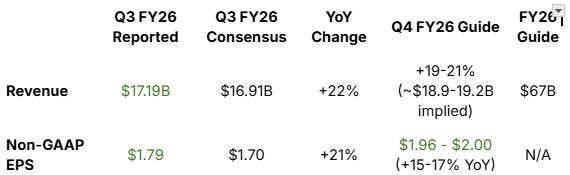
Numbers in green indicate a beat or raise.
Key notes:
Guidance
Q4 FY26 cloud revenue growth +46% to +50% USD; implies ~$9.8B-$10.1B.
FY26 guidance for revenue ($67B) and CapEx ($50B) were unchanged.
FY27 revenue guidance was raised to $90B. No hard FY27 CapEx numbers will be provided until fiscal year-end.
Consolidated non-GAAP operating margins (43%) compressed 135 bps YoY. Consolidated GM is also trending down compared to both last quarter and last year. This is because, simultaneously, a) the business mix is shifting toward capital-intensive infrastructure, and b) a large amount of capacity is currently under construction. This creates drag on overall profitability.
Operational Highlights
Demand
Cloud infrastructure growth accelerated. Total cloud revenue grew 44% YoY, versus 34% YoY in Q2. IaaS grew 84%, compared to 68% in Q2 and 55% in Q1. Oracle Cloud Database revenue grew 35%. Multicloud Database, which carries 60-80% GMs, grew 531% YoY.
RPO reached $553B, up $29B sequentially. Most of the new RPO is tied to large AI contracts funded upfront by customers (via prepayments or customer-owned hardware), reducing Oracle’s capital intensity. This lessens cash-flow burden, but pressures margins. If the customer supplies hardware and/or capital, Oracle captures significantly less of the value chain – it risks transitioning from into a lower-margin, glorified data center REIT. From the press release:
“...Oracle does not expect to have to raise any incremental funds to support these contracts as most of the equipment needed is either funded upfront via customer prepayments so Oracle can purchase the GPUs, or the customer buys the GPUs and supplies them to Oracle.”
Revenue is increasingly driven by a small number of massive contracts with hyperscalers/model providers. In an obvious reference to OpenAI concerns, management noted that customers’ financial positions have improved – but customer concentration risk remains.
AI infrastructure
Execution metrics were stronger and management provided more granularity than last quarter. Oracle secured 10+ gigawatts of power/DC capacity over the next 3 years, with 90% of that capacity funded through partners. In Q3, the company claims to have reduced time from rack delivery to revenue by 60%, and delivered over 400 megawatts with 90% on or ahead of schedule.
Data center construction, hardware delivery, installation, and power availability will remain bottlenecks that will likely create erratic results.
Management claimed that the shift toward inferencing does not require data centers to be closer to population centers to reduce latency, noting that customers are focusing more on hardware architecture to address latencies. Management claimed that despite lacking the same metro-edge footprint as some competitors, it is less disadvantaged by its strategy of building where power and land are abundant (rather than where population density is highest). While there is some merit to Oracle’s argument, it is workload dependent.
32% GM on delivered AI capacity. Management expects GM to improve as fixed costs spread and adjacent, higher-margin services (ex: storage) are attached to compute deals. Even if this trend materializes, it is unlikely to last – Oracle’s move to have customers pay upfront suggests lower long-term margins.
SaaS resilience
Management pushed back against the idea of SaaS disruption. They instead framed themselves as a beneficiary, stating that customers want to build/embed their own agents natively within Oracle’s secure ecosystem, reinforcing the stickiness of the system of record. Additionally, AI code generation improves software output with lower costs. From the press release:
“This new AI Code Generation technology is enabling us to build more software in less time with fewer people. Oracle is now building more SaaS applications for more industries at a lower cost.”
Oracle claims to be more insulated than many SaaS vendors but ultimately leadership did not address the paradox: if barriers/costs to build enterprise-grade software are plummeting, Oracle’s applications moat – the complexity and scale of its ERP/HCM systems – will weaken.
Strategic Initiatives
Capital structure
In order to fund the infrastructure buildout, Oracle raised $30B through investment-grade bonds and mandatory convertible preferred stock. This reduces the probability of a near-term negative spiral where backlog growth stresses the balance-sheet, which in turn raises the cost of financing.
While the $30B raise addresses immediate fears, Oracle has not yet initiated the $20B at-the-market (ATM) equity portion of its previously announced $50B financing program, leaving a dilution overhang on the stock.
TikTok investment
Oracle now holds a 15% equity stake and a board seat in TikTok (a result of TikTok US completing its separation from ByteDance). This will be recognized as non-operating income starting in Q4. Investment in the highly successful social media business can provide stability and upside for Oracle.
Historic Lookback
Oracle’s story has evolved from early AI demand validation, to hyperscale backlog expansion, to financing scrutiny, to proof of conversion/profitability.
Q1 FY26: Backlog skyrocketed, driving a massive stock rally. However, early warning signs emerged regarding CapEx required to actually build out the backlog and the lack of a clear financing plan.
Q2 FY26: RPO rose again, but investor focus was on Oracle’s deteriorating balance sheet, ballooning net debt, and rising CDS rating. Management was vague regarding buildout costs and financing strategy, leading to a post-earnings selloff.
Q3 FY26: Leadership preemptively addressed financing concerns in the earnings press release and provided more concrete operational detail during the call. The tone was slightly less promotional than in H1 FY26.
Investment Thesis
Oracle’s Q3 messaging and presentation alleviated investor concerns and restored some much-needed credibility into forecasts.
The company shared that financing risk is more manageable than feared, specifically reducing concerns that Oracle must fund all incremental AI capex directly from its own balance sheet.
The question now is whether Oracle can earn attractive returns as the revenue mix shifts toward infrastructure. Management did enough to address key issues, but now they must demonstrate through execution.
 | A guest post by
|